Torsion Testing Equipment, Torsion Testing Machine
Product Code: Torsion_Test
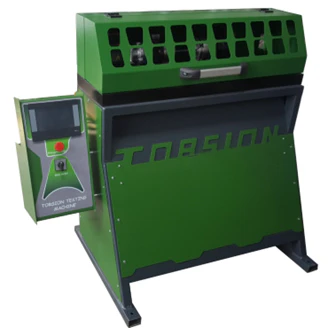
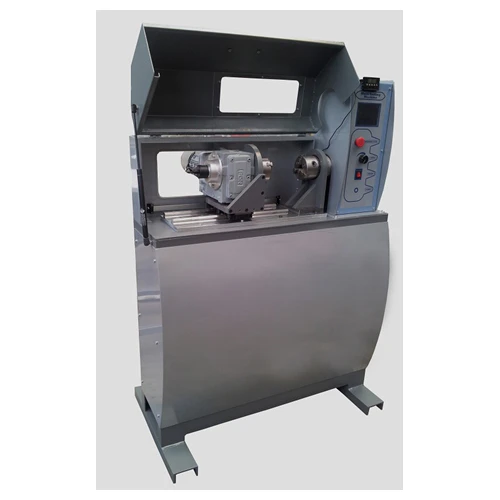
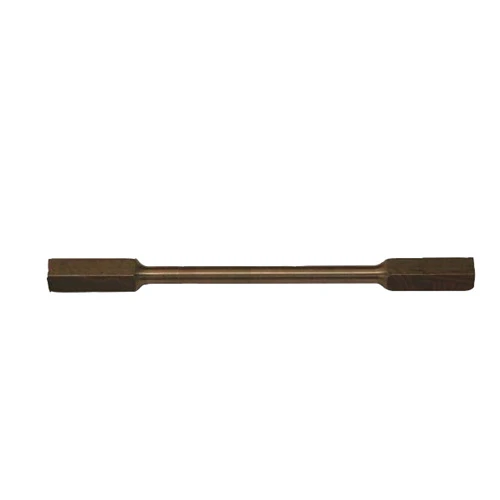
Application: Torsion Strength Testing of Materials and Products
Torsion tests are used to evaluate the torsional strength, hardness, and stress-strain properties of materials and products. These tests involve bending a material or test component to a certain degree with a specific force or until the material fails under torsion.
The twisting force in a torsion test is applied by securing one end of the test specimen so it cannot move or rotate, and then applying a moment to the other end to rotate the specimen around its own axis. A twisting moment can also be applied to both ends of the specimen, but the ends must be rotated in opposite directions.
What is the Purpose of a Torsion Test?
The purpose of a torsion test is to determine the behavior exhibited by a material or test specimen when twisted or under torsional forces, as a result of applied moments that cause shear stress around the axis. Measurable values include: shear modulus of elasticity, yield shear strength, torsional fatigue life, ductility, ultimate shear strength, and modulus of rupture in shear.
These values are similar but not the same as those measured by tensile testing. They are also important in manufacturing because they can be used to simulate service conditions, check the quality and design of the product, and ensure it is manufactured correctly.
What are the Different Types of Torsion Tests?
Three common forms of torsion testing include failure, proof, and operational. A failure torsion test requires the specimen to be twisted until it breaks and is designed to measure the strength of the specimen. A proof test is designed to observe the material under a specific torque load for a certain period of time. Finally, an operational test measures the performance of the material's application under expected service conditions.
What are the Different Types of Torsion Test Materials?
Many materials experience torque or torsional forces in their applications and therefore benefit from or require torsion testing. Materials used in structural, biomedical, and automotive applications are among the more common materials that experience torsion in their applications. These materials can consist of metals, plastics, woods, polymers, composites, or ceramics, among others, and generally take the form of fasteners, bars, beams, pipes, and wires.
What are the Commonly Applied Torsion Test Standards?
- ASTM A938: Torsional Test of Wire
- ASTM D1043: Torsion Plastics Test Equipment
- ASTM D5279: Thermoset & Thermoplastic Dynamic Torsion Testing Machine
- ASTM E2207: Axial-Torsional Fatigue Thin-Walled Tubular Materials Test Equipment
- ASTM F383: Static Bend and Torsion Testing of Intramedullary Rods
- ASTM F543: Medical Bone Screw Torsion Test Equipment
- ISO 6475: Bone Screw Torsion Test Methods | Equipment
- ISO 7800: Metal Wire Torsion test
- ISO 80369-1: Axial Torsional Luer Connector Test Equipment
What are Common Torsion Test Applications?
- Torsion Testing Machines for Plastics
- Torsion Testing of Bone Screws
- Torsion Testing of Wires
- Torsion Testing in Designed Composite Materials
- Torsion Testing Machine
- Static Axial Loaded Torsion Testing Machine
- Wire Torsion Strength Testing
What is a Torsion Testing Machine?
Torsion testing machines measure the torsional strength, hardness, and stress-strain properties of materials and products, making them ideal solutions for biomedical, automotive, and aerospace applications. Torsion testing machines are used to simulate real-life service conditions and check product quality for products such as drill bits, medical devices, screws and other fasteners, wire, and much more.
How Does a Torsion Machine Work?
The twisting force (torque) in a torsion test is applied by securing one end of the test specimen so it cannot move or rotate, and then applying a moment to the other end to rotate the specimen around its own axis.
Features
- This device is designed to determine the torsional resistance of metallic materials.
- The device can be designed according to different capacities.
- There are 9 different models available with capacities of 100-200-300-400-500-750-1000-2000-3000 NM.
- The device consists of the following main parts: two holders (one fixed and one movable), a 0.1-degree precision encoder, a torque cell that varies according to capacity, an automatic control panel with a color touchscreen, a silent operating movement group with adjustable speed, bidirectional use with a maximum of 3 rpm, and a frame.
- Dimensions: 760x1100x1060 mm
- Weight: 150 kg