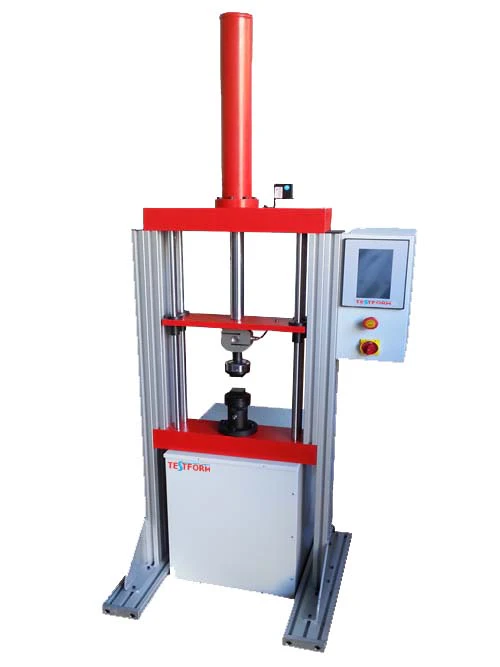
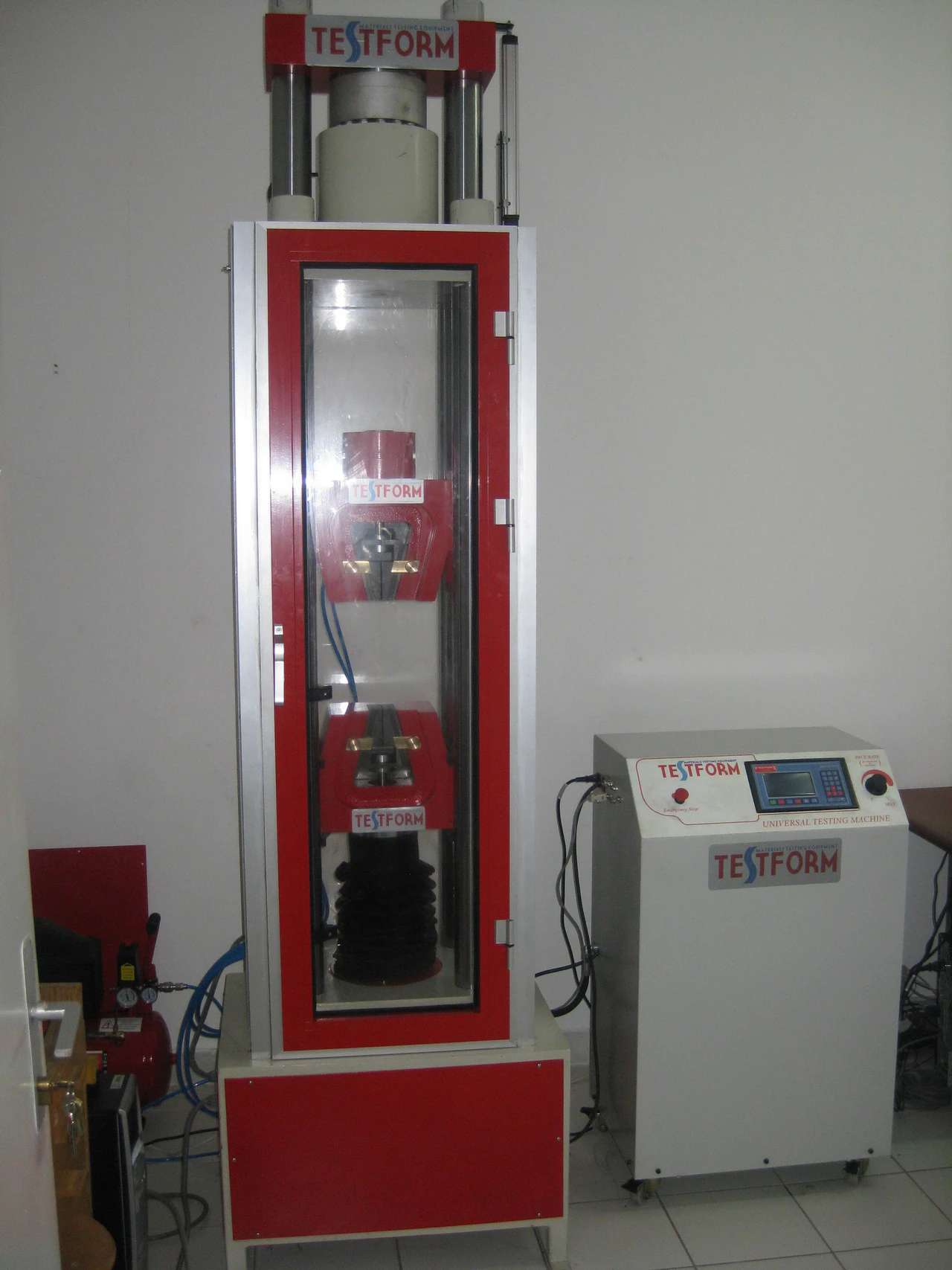
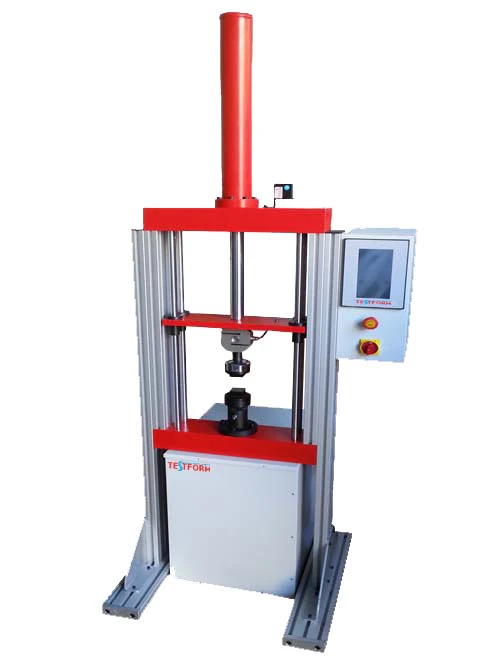
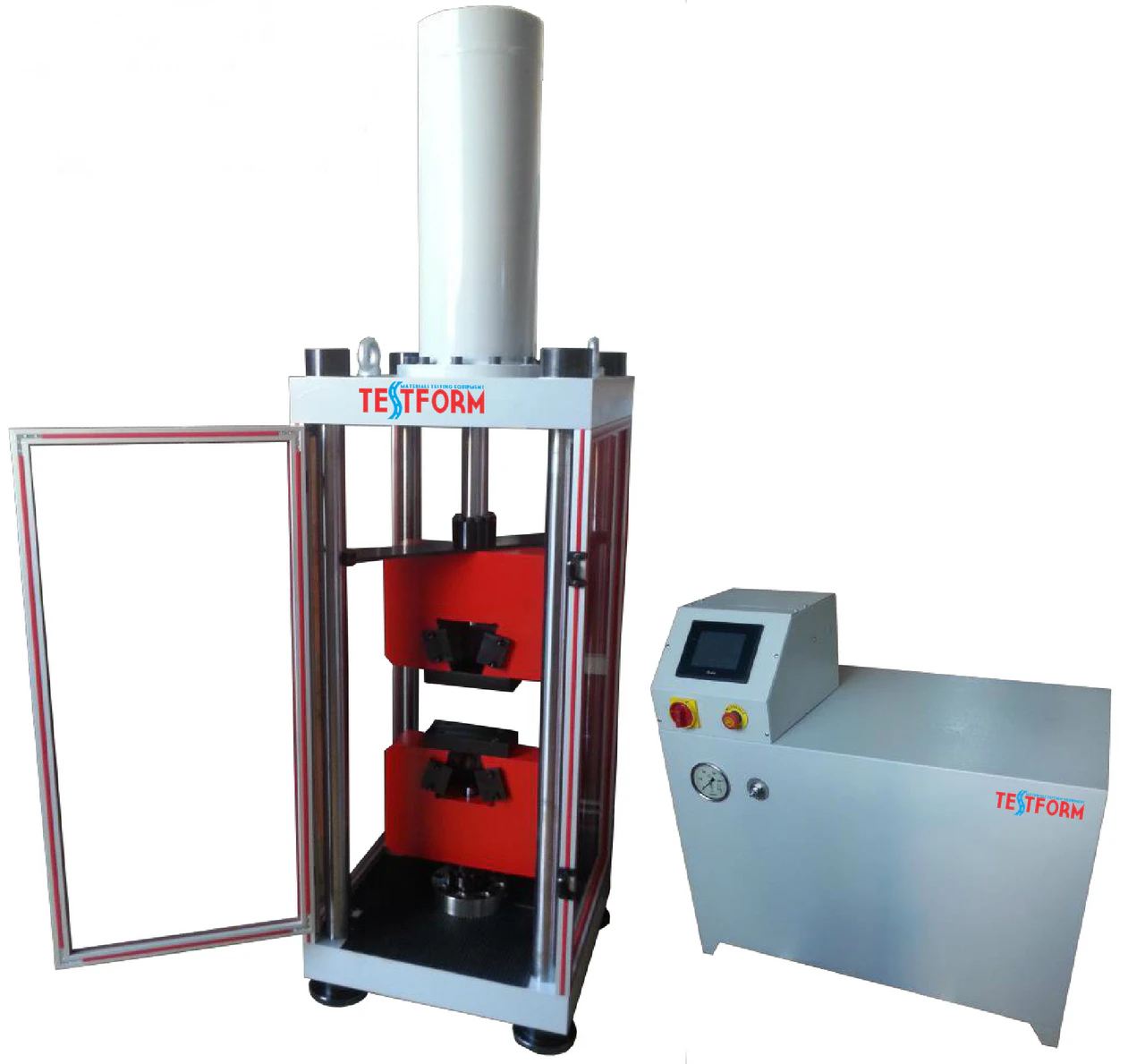
Dual-Field Electro-Hydraulic Servo Universal Testing Machine
Product Code: DHDC
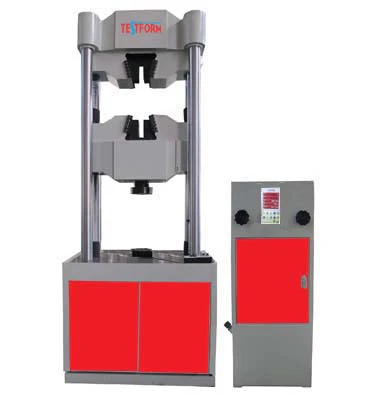
The DHDC series computer-controlled servo-hydraulic testing machine is suitable for testing the tensile, compressive, bending, and shear strength of various metallic and non-metallic materials. The dual-space servo-hydraulic testing machine, equipped with electronic, computer, and software packages, can control test procedures with pre-determined programs. The computer-controlled servo-hydraulic testing machine can also display, save, process, and print test results. Test graphs can be automatically drawn in real-time. The servo-hydraulic testing machine is easy to use and is versatilely used in applications of metallurgy industries such as steel mills, rebar manufacturers, aircraft manufacturers, research institutes, laboratories, calibration institutes, etc.
Applied Standards
The device meets the following international standards:
- Load Measurement: ASTM E4, ISO 7500-1, EN 10002-2, BS 1610, DIN 51221
- Strain Measurement: ASTM E83, ISO 9513, BS 3846, EN 10002-4
- Safety: European CE Health and Safety Directives (EN 50081-1, 580081-1, 73/23/EEC, EN 61010-1)
- Tensile Test: DIN EN 10002-1, ISO 6892, ASTM A370, ASTM E 8
- Steel Tensile Test: ASTM A615/A615M, ISO 10606, EN 10080
- Compression Test: DIN 1048, ISO 6784, ASTM C39, ISO 4506
- Bolt Tensile Test: ASTM F606-07
- Wire Tensile Tests: ASTM A416, BS 5896
- Shear Modulus: ASTM D143
- Concrete Plate: ASTM A185/A185M-07
Load Frame Structure
Test loads with high rigidity dual test spaces are available between 600kN and 3000kN to meet comprehensive test applications.
- It has a compact design with a robust four-column and two-screw structure.
- There is a dual workspace. The upper part is for tensile testing (expandable for peeling and tearing tests, etc.), while the lower part is quite suitable for compression, bending, and shear tests of different types.
- The frames have taken all human factors in the design into account to ensure safety, increase test efficiency, and provide ease of use for operators.
- The cylinder mounted under the device guarantees the working weight.
- The test area can be expanded according to the length and elongation of the specimen and other relevant test requirements.
Crosshead
The design of the front-open hydraulic wedge grips facilitates changing the jaw surfaces and specimen loading. The tensile grips are placed on the upper fixed and lower movable crosshead to maintain maximum strength. The movable crosshead driven by a roller chain makes the operation much easier.
Hydraulic Power Unit
- The variable pressure hydraulic power supply provides pressure on demand, reduces heat, extends oil life, and eliminates the need for water cooling.
- Dual Control Mode: Manual control and PC servo control model. The manual control mode is for manually loading the specimen hydraulically for high test efficiency. In PC servo control mode, the entire process is automatically controlled by the computer. Closed-loop servo control of position, load, stress, and strain is available.
- Pumping units are designed for laboratory use with lower noise levels within 65dBa.
Grips and Fixtures
Grips, Fixtures, Clamps, Jaw Adapter Surfaces, Couplings, and Adapters are in accordance with standards, and their design and production belong to our company. All capacities are produced according to needs. Production is carried out to provide the most comfortable testing opportunities for the user during the design phase.
Wedge Grip
Wedge grips provide the advantage of high clamping force during application. The clamping force is transmitted to the specimen through shaft-to-shaft or jaws. The main clamping force is first created by the wedge effect during the tensile process. The advantage of this type of grip is that the slip characteristics are firmly secured at the beginning of the application.
Test Fixture for Bending Tests
Bending Tests are one of the most common applications. In these tests, bearing radius, condition, and specimen thickness are important factors. The parameters of Bending Tests are usually determined by 3-Point or 4-Point Bending Test.
- Specialized bending fixtures that meet different test norms are offered to the customer.
- Special bending test systems are available for your industry and test applications.
- Thanks to the easy use of bending test systems, very different specimens can be tested quickly and accurately.
- The freely adjustable bearing housing allows testing of specimens of different lengths and makes your test system versatile.
Test Fixture for Compression Tests
In compression tests, the specimen is pressed until it breaks, cracks, or is crushed to a certain degree. For an effective test, the specimen must be placed properly on the platen. Determining factors; The size, shape, surface, material, and surface roughness of the stamping plates.
- Different stamping plates and customer-specific plates are offered.
- Complex compression test systems and special combinations for different specimens, materials, and part tests are available.
- The central engraving option facilitates specimen positioning.
- When verification of the specimen during testing is desired, the stamping plates can be combined with a rigid or arbitrary circular element.
Extensometer
The amount determined by extensometer strain between two points is determined during tensile or compressive material.
Standard Features
- Scissor-type grip system
- 0.01 mm extension sensitivity
- Adjustable in the range of 0-200 mm
- Stroke Lo + 300 mm
- Applicable to all devices
- Computer connection
- Material testing program with graph drawing capability
Additional Features
- Long stroke option
- Opportunity for special software programs according to user requests
Technical Specifications
- Height: 50 cm
- Width: 25 cm
- Depth: 25 cm
- Weight: 20 kg
Model Comparison Table
| Model | DHDC-600 | DHDC-1000 | DHDC-2000 | DHDC-3000
Related Products |
|---|